
Hello! I am Vinícius, a PhD student in statistics at Carlos III University of Madrid, in Spain. My current research lies in statistical inference for data in non-Euclidean spaces.
More broadly, I am interested in statistical dependence, causal inference, and the foundations of statistics. My general interests are related to understanding how the notion of causality and statistical association are formally connected, how to make inductive inferences, and how to quantify my uncertainty about such inferences; those questions naturally drew me to pursue both a bachelor's and a master's degree in statistics at the University of Campinas, in Brazil.
As specific research subjects, I developed an interest in copula theory, structural causal models, conditional independence, and exchangeability. I also read, as a hobby, a bit about factor analysis, extreme value theory, robustness, and the philosophy of statistics.
If you would like to discuss any topic in either statistics, probability, or the philosophy of statistics, feel free to email me in either English, Portuguese, or Spanish! :)
Main research interests: copula theory, structural causal models, conditional independence, exchangeability, and directional statistics.
Warning
Problem: The current name of your GitHub Pages repository ("Solution: Please consider renaming the repository to "
http://".
However, if the current repository name is intended, you can ignore this message by removing "{% include widgets/debug_repo_name.html %}" in index.html.
Action required
Problem: The current root path of this site is "baseurl ("_config.yml.
Solution: Please set the
baseurl in _config.yml to "Education
-
 Carlos III University of Madrid (Spain)Department of Statistics
Ph.D. Student2025 - present -
 University of Campinas (Brazil)MSc. in Statistics2023 - 2024
 -
University of Campinas (Brazil)B.S. in Statistics2019 - 2022
Experience
-
Carlos III University of Madrid (Spain)Department of Statistics
Predoctoral Researcher2025 - present
Honors & Awards
-
Top ranked applicant admitted to a Master's program in Statistics with a scholarship - University of Campinas.2023
-
Speaker at the graduation ceremony for the graduating class in statistics.2023
-
Bronze medal at the Brazilian Public School Mathematics Olympiad.2014
-
Bronze medal at the Brazilian Public School Mathematics Olympiad.2013
News
Selected Publications (view all )
Covariate-adjusted statistical dependence representation through partial copulas: bounds and new insights
Vinícius Litvinoff Justus, Felipe Fontana Vieira
ArXiv preprint 2026 Spotlight
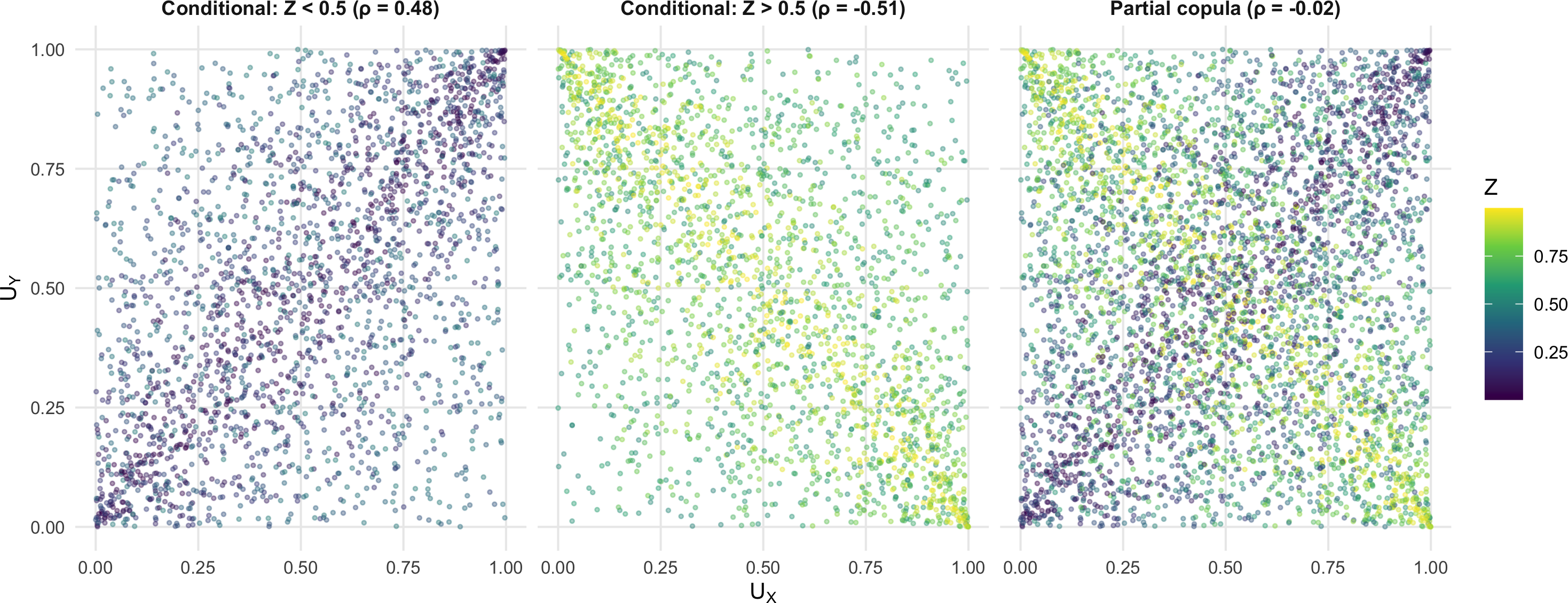
In this paper, we revisit the notion of partial copula, originally introduced to test conditional independence, highlighting its capability to represent the dependence between two random variables after removing their dependence with a covariate. Building upon results previously presented in the literature, we show that partial copulas can be seen as a nonlinear analogue of partial correlation. Then, we prove several results showing how dependence properties of the conditional copulas constrain the form of the partial copula. Finally, a simulation study is conducted to illustrate the results and to show the potential of partial copula as a way to describe covariate-adjusted statistical dependence. This highlights the potential of the method to be used in causal inference problems and recover the true sign of a causal effect.
Covariate-adjusted statistical dependence representation through partial copulas: bounds and new insights
Vinícius Litvinoff Justus, Felipe Fontana Vieira
ArXiv preprint 2026 Spotlight
In this paper, we revisit the notion of partial copula, originally introduced to test conditional independence, highlighting its capability to represent the dependence between two random variables after removing their dependence with a covariate. Building upon results previously presented in the literature, we show that partial copulas can be seen as a nonlinear analogue of partial correlation. Then, we prove several results showing how dependence properties of the conditional copulas constrain the form of the partial copula. Finally, a simulation study is conducted to illustrate the results and to show the potential of partial copula as a way to describe covariate-adjusted statistical dependence. This highlights the potential of the method to be used in causal inference problems and recover the true sign of a causal effect.